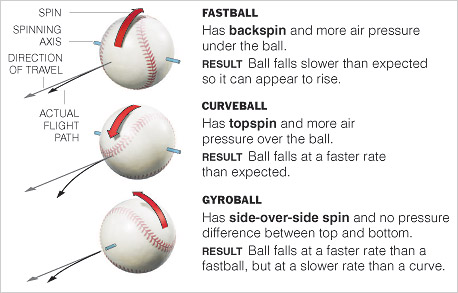
A good pitch in baseball is entirely affected by the type of spin and the spin rate. Each pitch spins in a different way depending on how the pitch is thrown. For example, fastballs have a lower rate of backspin which causes them not to move too much. Conversely, curveballs have a lot of top spin which makes them have a hard break once the pitch has reached its peak.
 Another thing that drastically affects the pitch may seem like very small differences, but in reality are very big impacts. One of these is the height of the seams on the ball. At the high school level, the seams are raised on every ball, which creates more friction. This means that the ball moves slower, but also has a lot more movement. This can impact each pitcher in a different way. If someone is primarily a fastball dominant power pitcher, they would be negatively impacted by the ball because they could lose 1-2 miles per hour. On the other hand, at the major league level, the seams are very low, which benefits fastball pitchers.
 The type of ball that is being used can also affect the way the ball is hit. The high seem ball does not travel as far because the ball is less perfectly round and can be hit imperfectly. However, the low seam ball travels a lot farther. I prefer the low seam ball because I feel like I have more control over it, and it limits the blisters I get on my hand, which can be very annoying.

Comments
Post a Comment